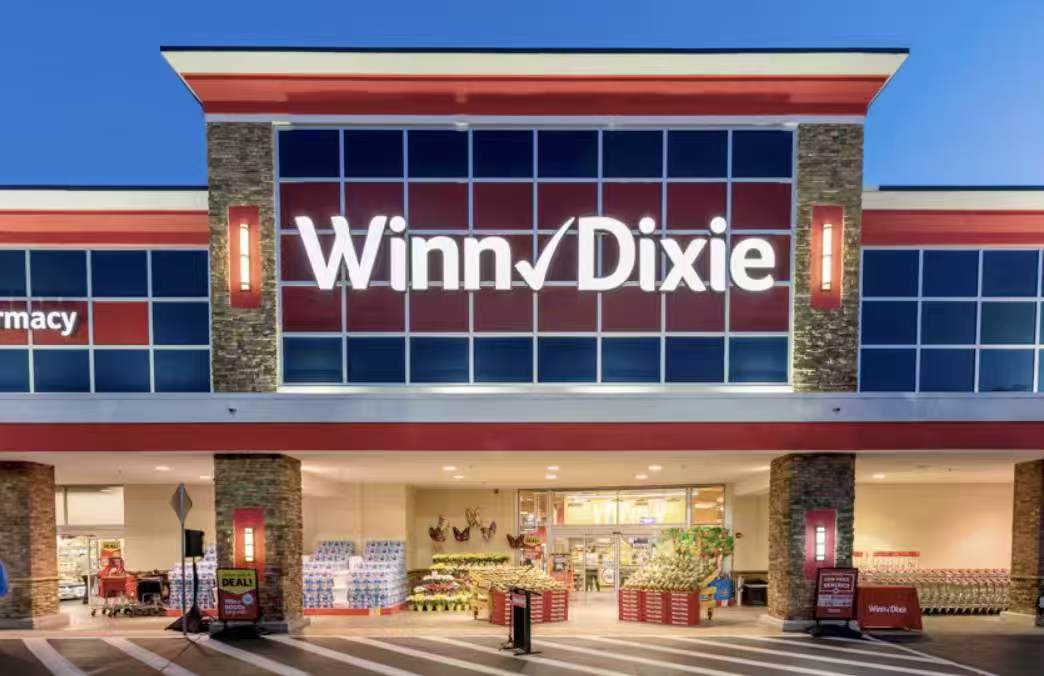
Exterior view of a Winn-Dixie supermarket, the flagship brand of Southeastern Grocers, soon to be rebranded as The Winn-Dixie Company.source from:Wikipedia
Winn-Dixie Rebrands as Southeastern Grocers Refocuses on Florida
Southeastern Grocers, one of the Southeast’s most recognized regional food retailers, is turning a century-old legacy into a fresh start. Beginning in early 2026, the company will officially rebrand as The Winn-Dixie Company, signaling a sharp strategic pivot: exiting most markets outside Florida and Georgia to strengthen its home-state presence.
This rebrand represents more than a name change. It’s a rare case of a heritage grocer reinventing itself amid an era of consolidation, e-commerce disruption, and regional competition from deep-pocketed national chains like Publix, Aldi, and Walmart.
A “Brand-New 100-Year-Old Company”
Under the new name, The Winn-Dixie Company plans to operate roughly 130 traditional grocery stores and 140 liquor stores across Florida and southern Georgia. The company is shedding 40 stores in Alabama, Georgia, Louisiana, and Mississippi — including 32 Winn-Dixie and 8 Harveys Supermarket locations — through agreements with multiple regional grocers.
Meanwhile, it’s simultaneously expanding in Florida, its strongest and most profitable territory. Winn-Dixie has finalized the acquisition of Hitchcock’s Markets in Alachua, Keystone Heights, and Williston, with plans to convert them into Winn-Dixie locations. The first new store in Williston is scheduled to open in December 2025, followed by the Alachua and Keystone Heights locations by summer 2026.
CEO Anthony Hucker described the move as “accelerating growth where our roots run deepest.” In his words, “Winn-Dixie’s story is built on the resilience and spirit of Florida’s people — and that foundation will guide our next century.”
Shrinking the Map, Expanding the Brand
Southeastern Grocers’ transformation is not a retreat — it’s a reorientation. The company has spent the past three years restructuring its portfolio amid shifting ownership and evolving market dynamics.
•2023: German discounter Aldi acquired the Winn-Dixie and Harveys divisions to expand its U.S. footprint.
•2024: SEG sold its Hispanic-focused Fresco y Más chain to Fresco Retail Group, based in Coral Gables, Florida.
•Early 2025: A private investor consortium acquired SEG and its grocery banners back from Aldi U.S., setting the stage for this rebranding initiative.
The company now aims to focus on regional strength over national sprawl, echoing a broader retail trend: localizing operations to deepen community ties and sharpen brand identity.
Reinventing the In-Store Experience
Beyond geography, Winn-Dixie’s relaunch involves a physical and digital overhaul. The company has dozens of remodels and new builds underway, aiming to create “inviting, community-centered stores” that emphasize convenience and local connection.
A major component of the reboot includes:
•Expanding its liquor store portfolio with new retail formats;
•Reintroducing the popular “Lip Lickin’ Chicken” line in early 2026;
•Growing its private-label product range to compete with Publix and Trader Joe’s;
•Testing online grocery delivery partnerships with DoorDash and Amazon.
These moves reflect Winn-Dixie’s push to modernize its in-store and digital ecosystem without losing its Southern neighborhood charm — a delicate balance in an industry increasingly defined by automation and data-driven personalization.
Strategic Context: Betting on Florida’s Growth
Winn-Dixie’s renewed focus on Florida is a calculated move. The Sunshine State’s population has surged by nearly 700,000 in the past two years, according to U.S. Census data, making it one of the nation’s fastest-growing retail markets. Rising household incomes and continued migration from the Northeast and Midwest have fueled grocery demand across urban and suburban regions alike.
By narrowing its operational footprint, Winn-Dixie gains agility to compete in a high-growth, high-margin market it understands intimately. The company’s deep cultural and brand roots in Florida — reinforced by decades of advertising and community engagement — offer a defensible moat against low-cost competitors.
As retail analyst Mark Thompson put it, “This isn’t just a rebrand — it’s a geographic consolidation strategy disguised as a heritage revival.”
A New Chapter in a Century-Long Story
The upcoming transition marks a full-circle moment for the Winn-Dixie brand, which has survived bankruptcies, mergers, and ownership changes since its founding in 1925. While the grocery industry has seen countless regional players fade, Winn-Dixie’s evolution underscores a critical insight: staying local may now be the smartest way to survive global competition.
As it enters its next hundred years, The Winn-Dixie Company is betting that focusing deeply, not broadly, will deliver both resilience and relevance.
This article references data and reporting from[ChainStoreAge]