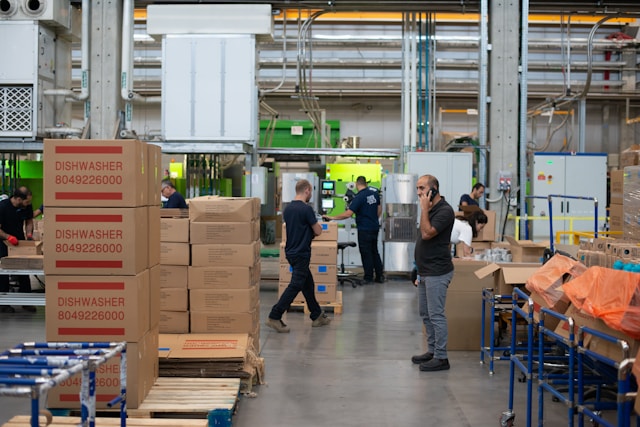
For Macy’s, the decision to close a large fulfillment center outside Tulsa is less about retrenchment and more about control. As the retailer pushes forward with a multi-year turnaround plan, the move underscores a clear priority for 2026: simplify the supply chain, reduce fixed costs, and concentrate volume in fewer, more automated hubs.
The Tulsa, Oklahoma facility is slated to close this spring, according to a company spokesperson, making it the latest node to be removed as Macy’s reshapes how merchandise flows from warehouse to customer.
A Facility Built for a Different Era of E-Commerce
Macy’s first announced the Tulsa-area direct-to-consumer fulfillment center in 2013, when rapid e-commerce expansion demanded sheer square footage. The 1.3 million-square-foot site went live in 2015 and was expected to employ up to 1,500 full- and part-time workers, plus roughly 1,000 seasonal associates.
A decade later, the economics of fulfillment have changed. Faster delivery expectations, higher labor costs, and advances in automation have shifted the advantage toward fewer, more technologically sophisticated facilities. The Tulsa center—designed for scale rather than speed or flexibility—no longer fits neatly into that model.
Employees Notified as Network Is “Rightsized”
Macy’s confirmed that employees at the Tulsa location have already been informed of the closure. Where possible, workers are being offered transfer opportunities, along with severance and support where applicable. The company has not disclosed how many roles will ultimately be affected.
In its statement, Macy’s framed the move as part of a broader effort to modernize its supply chain and simplify operations in order to better serve customers—language that aligns closely with recent executive messaging.
Inside the “Bold New Chapter” Supply Chain Reset
The Tulsa closure sits squarely within Macy’s “Bold New Chapter” strategy, an initiative unveiled to analysts in 2024. The plan targets roughly $235 million in cost savings by 2026 through operational efficiencies, including supply chain consolidation.
In a recent internal memo, CEO Tony Spring told employees that these changes are already producing faster and more reliable operations. That confidence is rooted in heavy investment elsewhere in the network.
Most notably, Macy’s opened a 1.4 million-square-foot automated fulfillment and store replenishment center in China Grove, North Carolina, in October. The facility is expected to handle nearly 30% of the company’s digital supply chain volume—an enormous share that reflects a deliberate shift toward automation-driven scale.
Not an Isolated Closure
Tulsa is not the only location affected by Macy’s network redesign. The retailer also began phasing out an operating unit at a Connecticut distribution center starting late December, a move that impacted 106 employees.
Taken together, these closures suggest a broader pattern: Macy’s is pruning legacy assets while concentrating investment in fewer, high-capacity hubs that can serve both e-commerce and store replenishment more efficiently.
StoreTechNews Analysis: Efficiency Over Footprint
From a strategic standpoint, Macy’s actions mirror a wider retail logistics trend. The era of sprawling, labor-heavy fulfillment networks is giving way to precision logistics—where automation, throughput, and proximity to demand matter more than raw size.
For Macy’s, the risk is execution. Consolidation can improve margins and service levels, but it leaves less room for error during peak periods. The upside, however, is significant: a leaner supply chain better aligned with today’s omnichannel reality.
If the company’s automated hubs deliver as promised, the Tulsa closure may ultimately be remembered not as a retreat, but as a necessary step in redefining Macy’s logistics backbone for the next decade.
Source: Based on reporting from Retail Dive