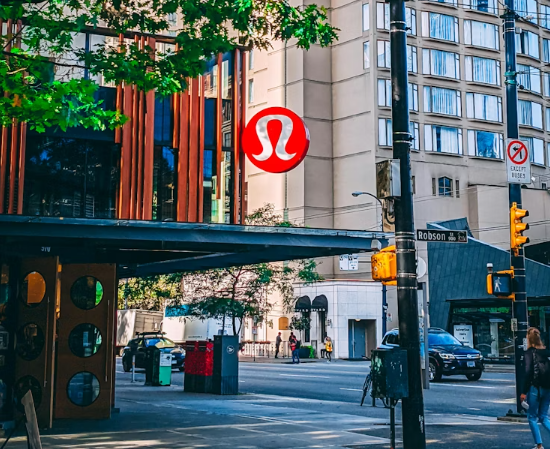
Lululemon is entering 2026 without a permanent CEO — and with its founder openly questioning whether the brand still knows who it is. The announced departure of CEO Calvin McDonald after seven years at the helm has triggered a rare public rebuke from founder Chip Wilson, exposing deeper tensions around product innovation, brand identity, and long-term growth.
While most Wall Street analysts credit McDonald with years of strong execution, the timing of his exit — amid slowing U.S. momentum — underscores a pivotal reality: Lululemon’s next chapter will be harder than its last.
The Numbers Tell a Mixed Story
On paper, Lululemon remains a growth company. In its latest earnings report, revenue rose 7% year over year to $2.6 billion. Comparable sales were up 1% globally.
But beneath the headline figures lies a more concerning signal: sales in the Americas declined 2%, and regional comps fell 5%. For a brand whose dominance was built in North America, that softness matters far more than headline growth.
The contrast highlights Lululemon’s current dilemma — international expansion is still working, but its core market is showing signs of fatigue.
Chip Wilson’s Critique: Governance, Not Just Performance
Founder Chip Wilson wasted little time weighing in. In a sharply worded statement, he said he was “deeply concerned” that Lululemon’s board lacked a clear succession plan and accused leadership of overseeing years of brand value erosion.
His core argument is not about short-term sales fluctuations. Instead, Wilson frames the issue as structural: a shift away from being a “product-first” company and a failure to hold management accountable for innovation.
In Wilson’s view, the dilution of Lululemon’s premium positioning in its core markets signals a deeper disconnect between leadership and its target customer — a charge that goes directly to the heart of brand stewardship.
Lululemon declined to comment on Wilson’s remarks.
Where the Founder Has a Point
Not all of Wilson’s criticism is easily dismissed. Earlier this fall, Lululemon’s management acknowledged that product execution had slipped. McDonald himself admitted the brand had become “too predictable” and had failed to set new trends — a dangerous admission in a category built on design leadership.
In response, the company announced a reset of its product design and development process. The goal: faster cycles, fresher assortments, and a renewed focus on innovation rather than iteration.
That admission alone suggests Wilson’s concerns are not purely ideological.
McDonald’s Defense: A Product Revival in Progress
On his final earnings call, McDonald emphasized that a turnaround was already underway. Working closely with Creative Director Jonathan Cheung, he pointed to a stronger product pipeline set to roll out in spring 2026.
Key highlights include:
•A target of 35% new-style penetration by spring
•Innovation across core categories such as training, running, yoga, golf, and tennis
•A new fabric platform designed specifically for weight training
•Renewed focus on leggings and tops — Lululemon’s profit engines
Interim co-CEO and CFO Meghan Frank echoed that message, stressing improved speed and agility across the product organization.
In short, management argues the fix is already in motion — even if leadership continuity is not.
Analysts: Right Change, Risky Timing
Most analysts agree that a leadership transition was inevitable. Guggenheim described the CEO exit as giving Lululemon “breathing room” to reset, while also warning about potential brand saturation in the U.S.
Others are less sanguine about the timing. Needham’s Tom Nikic noted that the company’s outlook has become “cloudier,” while GlobalData’s Neil Saunders called the move “sudden and hasty,” arguing that Lululemon now lacks clear strategic direction at a critical moment.
Saunders summed it up bluntly: the brand has lost its captain just as the waters get rougher.
Competitive Pressure Is the Real Test
Leadership drama aside, Lululemon’s biggest challenge may be external. Competition in premium athleisure has intensified dramatically. Brands like Alo Yoga and Vuori are no longer niche challengers — they are credible alternatives with strong cultural momentum.
Wells Fargo analysts recently described Lululemon as being in “uncharted waters,” citing more than a year of negative U.S. comps, slowing innovation in core products, and rising pressure from newer entrants.
This context matters. Even the strongest CEO would struggle to engineer easy growth in today’s athleisure market.
What Comes Next for Lululemon
Looking ahead, Lululemon expects Q4 net sales to decline 1% to 3%, or rise 2% to 4% when excluding last year’s extra week. Full-year revenue is projected to grow about 4% to roughly $11 billion.
But numbers alone will not define the next era. The company’s CEO search — and the board’s willingness to clarify strategy — will send a strong signal to investors, employees, and customers alike.
The central question is no longer whether Lululemon can grow. It’s whether the brand can rediscover the innovation edge that once made it indispensable.
Source: Based on reporting from Retail Dive