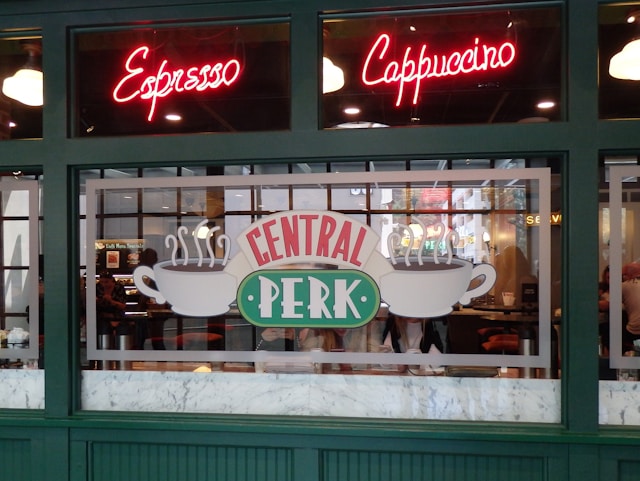
When Central Perk Coffeehouse opened its doors in Times Square this week, the headline wasn’t just about another Friends tribute. The real story is permanence. In an era dominated by pop-ups and short-term brand activations, Warner Bros. Discovery and its partners are making a long-term bet: that nostalgia, when paired with thoughtful design and solid food-and-beverage execution, can anchor a sustainable retail business in one of the world’s most expensive commercial districts.
At 3,000 square feet on the corner of Seventh Avenue and 47th Street, the new Central Perk is positioned not as a fleeting fan experience, but as a daily-use café embedded in the flow of Times Square foot traffic.
From TV Set to Retail Asset
The original Central Perk existed only on screen, serving as the emotional backdrop for Friends from 1994 to 2004. Over the past decade, however, the franchise has proven unusually durable, generating licensing revenue, streaming demand, and live experiences long after its final episode aired.
This Times Square café follows a familiar arc. A successful pop-up (The Friends Experience: The One in New York City) launched in SoHo in 2019. A first permanent Central Perk opened in Boston in 2023. New York was always the logical next step.
As Glen Coben, president of Glen & Co. Architecture, put it, the intention to open in New York City was there from the beginning. What changed is the confidence that this concept could live beyond novelty.
Design That References, Not Recreates
One of the most notable editorial decisions behind the Times Square location is what it avoids. Rather than building a museum-like replica of the sitcom set, the design team opted for what might be called “inspired familiarity.”
The iconic orange couch returns, but in an upgraded “Orange Sofa Room” designed as much for dining as for social media. Natural brick, jewel tones, marble tables, and a cup-and-saucer chandelier modernize the visual language, while expansive glass windows pull curious passersby inside — a crucial move in a neighborhood driven by impulse entry.
This approach reflects a broader shift in experiential retail: fans want recognition, not reenactment. They want to feel inside the brand without feeling trapped in a time capsule.
Art, Easter Eggs, and Local Relevance
The space is layered with references for attentive fans, from a mural echoing the show’s opening fountain to visual nods like Phoebe’s “A–Z” bookends and the silhouette of Joey and Chandler’s chick and duck.
Adding cultural continuity, pop artist Burton Morris — whose work appeared in more than 130 Friends episodes — contributes original pieces. His Empire State Building artwork faces the street, anchoring the brand to New York itself rather than to television nostalgia alone.
This balance between fandom and locality is essential. Times Square visitors may not all be Friends devotees, but they are all looking for a recognizable, approachable place to stop.
Food, Not Just Fandom
Crucially, Central Perk is positioning itself as a functioning café, not just a photo backdrop. The full-service coffee bar offers fresh food, snacks, beverages, and six original Friends-themed coffee blends, alongside exclusive merchandise developed specifically for the location.
The involvement of food-and-beverage experts, including chef Tom Colicchio, signals a clear intent: repeat visits will depend on quality, not just IP. This is where many themed venues fail — and where this one appears to be investing deliberately.
What This Signals for Experiential Retail
From a retail strategy standpoint, Central Perk Times Square illustrates three broader trends:
1.IP-driven spaces are maturing — moving from pop-ups to permanent, operationally serious locations.
2.Design now prioritizes usability — seating, flow, and comfort matter as much as visual references.
3.Food and beverage quality is non-negotiable — fandom may attract the first visit, but only execution earns the second.
In that sense, Central Perk isn’t just a coffeehouse. It’s a case study in how entertainment brands are evolving into place-based businesses that must perform like real retailers.
Whether this model scales further remains to be seen. But in Times Square, Central Perk is no longer a punchline or a backdrop. It’s open for business.
Source: Based on reporting from Chain Store Age